Single-Ply Membranes, Drainage & Repairs · Lehi & Wasatch Front
Flat & Low-Slope Roofing in Utah County & Salt Lake Valley
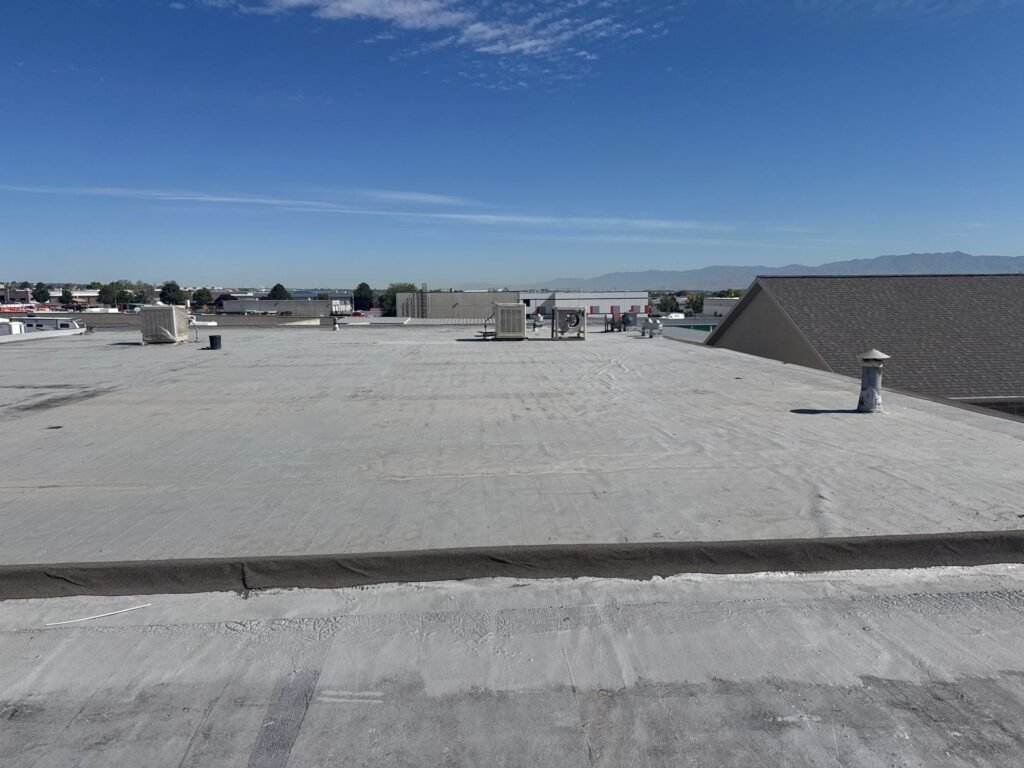
From persistent ponding water and split seams to complete TPO installations and energy-efficient re-covers, we install engineered single-ply membrane systems that keep low-slope properties leak-free under harsh Utah snow loads and intense UV exposure.
⭐⭐⭐⭐⭐ 5.0
Google Reviews
Licensed & Insured
Utah GC Lic. #13861046-5501
10+ Years
Serving Utah County
Certified Commercial
Residential Applicators

Active Flat Roof Leak or Standing Water?
Flat roof leaks rarely drip straight down from the breach; water travels along insulation boards and deck flutes before showing on your ceiling.
Then skip the form and call us. We provide prompt diagnostic tracing and emergency tarping, seam weighting, or temporary patches to protect your interior equipment and inventory while planning permanent repairs.
Is Your Flat Roof Failing? What to Look For
Low-slope and flat roofs face unique structural stresses from snow accumulation, freeze-thaw cycles, and UV breakdown. If your roof displays any of these warning signs, immediate action is required:

Ponding Water Lasting Longer Than 48 Hours
If water remains standing in low spots 48 hours after rain or snowmelt, your roof lacks proper slope. Standing water accelerates membrane breakdown, adds massive weight stress, and voids most manufacturer warranties.

Open Seams, Punctures, or Tenting
Single-ply seams can separate due to building shifting, failed adhesive, or improper original welding. Once a seam unzips, wind tears the sheet and allows water to saturate the insulation core underneath.

Spongy, Saturated Insulation Underfoot
Walking on the membrane should feel firm. If certain spots feel squishy or water bubbles beneath your boots, water has breached the membrane and saturated the polyiso insulation board below.

Blistering, Cracking, or Flashing Pull-Away
Extreme high-altitude Utah sunshine bakes older membranes, causing embrittlement, alligatoring, or metal edge flashing to pull away from parapet walls.
Not sure if your low-slope roof needs a targeted patch, a re-cover, or a complete replacement? We inspect your deck, drainage lines, and insulation, show you photo documentation, and provide an objective plan.
Comprehensive Flat & Low-Slope Roofing Services
Whether protecting a residential modern home addition, a detached garage, or a light commercial warehouse, our team delivers certified membrane applications tailored to your building.

Single-Ply Membrane Installations
- TPO Membrane Installation: High-reflectivity white thermoplastic polyolefin (TPO) heat-welded at the seams. Excellent UV reflection that slashes summer cooling costs across the Salt Lake Valley.
- PVC & EPDM Membrane Systems: Chemical- and grease-resistant PVC for restaurants and commercial facilities, alongside durable rubber EPDM membranes engineered for extreme thermal expansion and winter freeze-thaw durability.

Replacements, Re-Covers & Retrofits
- Complete Flat Roof Tear-Off & Replacement: Full extraction of saturated insulation, damaged decking, and degraded membranes down to the steel, wood, or concrete deck, followed by a brand-new engineered assembly.
- Single-Layer Re-Cover Systems: If the existing insulation core is dry and municipal building codes permit, we install a high-density cover board and new membrane over the old roof — saving thousands in labor and landfill disposal fees.

Drainage & Tapered Insulation Systems
- Tapered Polyiso Insulation: We engineer customized tapered insulation slopes that channel water toward drains and scuppers, permanently eliminating low spots and ponding water.
- Drain, Scupper & Parapet Detailing: Precision flashing of internal roof drains, exterior overflow scuppers, collector boxes, and metal parapet coping caps to guarantee watertight termination points.

Diagnostic Repairs & Commercial Services
- Flat Roof Repair & Robotic Seam Welding: Diagnostic leak tracking, hot-air seam re-welding, pipe boot retrofits, and puncture patching to stop localized moisture intrusion without a full replacement.
- Light Commercial & Retail Properties: Dedicated low-slope roofing services for storefronts, office buildings, churches, industrial units, and HOAs, scheduled to minimize tenant disruption.
Looking for pitched residential shingle work? Explore our dedicated Roof Replacement services.
What Affects Flat Roof Costs?
Pricing for flat and low-slope projects depends heavily on membrane chemistry, drainage design, and code requirements:
Membrane Selection & Thickness
45-mil vs. 60-mil or 80-mil reinforced TPO/PVC, mechanically fastened vs. fully adhered.

Insulation R-Value Requirements
Current energy codes dictate minimum continuous insulation thickness (R-30 in most commercial Utah jurisdictions).

Tapered Slope Complexity
The amount of custom crickets and sloped insulation needed to achieve positive drainage.

Tear-Off vs. Re-Cover
Installing directly over an existing single layer costs significantly less than a multi-layer tear-off involving saturated insulation disposal.
You’ll receive a clear, itemized proposal following your comprehensive on-site inspection.
Financing a large residential addition or commercial low-slope project? We offer customized payment plans — visit our financing page for details.
How We Restore or Replace Your Flat Roof in 4 Steps
From slope engineering to final seam probes, our installation process is meticulous.
1
On-Site Core Cut & Moisture Assessment
We inspect the membrane, take core samples to verify if the insulation core is dry or saturated, inspect drainage paths, and document every elevation with photos.
2
Engineered Proposal & Drainage Plan
You receive a firm, written quote outlining membrane options, R-value insulation specifications, drainage corrections, and manufacturer warranty tiers.
3
Certified Installation & Hot-Air Seam Welding
Our crew mechanically fastens or fully adheres the insulation boards, rolls out the membrane, and hot-air welds every seam with calibrated robotic welders, forming a continuous, monolithic barrier.
4
Seam Probe Inspection & Site Cleanup
We manually probe every welded seam to confirm full fusion, test drains and scuppers, haul away all construction debris, and issue your written warranty.
Why Property Owners Choose Rooval Roofing
Rooval Roofing is a local, family-run company headquartered in Lehi, serving Utah County and the Salt Lake Valley.

Licensed & Insured
Utah GC License #13861046-5501

Documented Inspections
Every inspection includes photos you keep
Workmanship Warranty
Written warranty on every flat roof project we complete

Financing Available
Flexible payment plans for unexpected repairs or replacements

Insurance Claims Support
Photo documentation ready for your adjuster
We’ll also tell you when a full replacement isn’t necessary at all — if that’s the honest answer, that’s what you’ll get.
5.0 ⭐⭐⭐⭐⭐ from Google Reviews
Utah GC Lic. #13861046-5501
Posted on Google
 Kendall Hawkins
Trustindex verifies that the original source of the review is Google.
We had leaks at our commercial warehouse bldg and Matthew jumped right on it for me, same day fix and was a great communicator throughout (texts and pictures etc). He helped me out and now is on my shortlist for roofers in the valley. Would recommend Rooval!Posted on Google CaseyWe had a roof leak and Matt was quick to respond and came out the next morning. He didn't try to pitch a whole roof replacement or anything he didn't think was necessary and the pricing was fair. I would recommend Rooval for a quick inspection/repair.Posted on Google
 kaden pieksmaMatthew and his team are extremely timely, easy to work with, knowledgeable, and offer competitive pricing. I would recommend them for any roofing needs.Posted on Google
 Stan JensenI was quite impressed with Matthew. He sent me a text to let me know he was on his way and he was actually on my doorstep probably less than one hour after I contacted them. We had a mystery roof leak that was dripping water through a can light in our hallway each time we've had a downpour of heavy rain. He quickly diagnosed the problem, made the repairs, checked in my attic for residual moisture, and left me with a warranty, and all was done in probably less than a couple of hours. He was very personable and pleasant to work with. I have confidence I don't need to worry anymore whenever we get a heavy rainstorm!Posted on Google
 Kara AdamsIf you need any roofing stuff done I would definitely recommend this company because of their great employees , especially Matt. He was very helpful and super nice. If we have any roofing problems in the future I will definitely come back to this company. I will definitely be putting this company number as a contact in my phone.Posted on Google
 Rob DuffinExperienced and honest. Highly recommend!Posted on Google
 Ben ChandiaMatthew is one of the best at what he does. He takes the extra time to go through and educate you on the reality of your situation and will then give you the best option available. He's a true pro and great at what he does.Posted on Google
 Landon TolmanMatthew, is a stellar guy Definitely someone you can trust doing business with!Posted on Google
 Oriana GrandiaHere's the deal, we made a mistake. We didn't go with Rooval Roofing for our new roof and we are regretting it now. We picked a company that wasn't as highly rated, but was a bit cheaper. We got what we paid for. Our roof has numerous issues and we aren't happy. We talked with Rooval and even though we didn't contract them for our roof they are still nice enough to help fix the problems we are having. This is a classic example of "you get what you pay for" so if you're on the fence I hope this review sways you in the right direction, and Rooval Roofing is the right choice! The company and its employees are first class. Don't make the mistake we did. The shortest road is always the longest.Posted on Google
 Rob OckeyGreat service, quick and reasonable pricing. Would call back if needed.
Areas We Serve
Serving flat and low-slope commercial and residential properties across Utah County and the Salt Lake Valley from our Lehi headquarters — including Lehi, Highland, Alpine, American Fork, Pleasant Grove, Orem, Provo, Draper, South Jordan, Sandy, and Salt Lake City.
Don’t see your city listed? Call (385) 424-8810 to confirm service area coverage.
Flat Roofing FAQs
What is the difference between TPO, PVC, and EPDM?
TPO is a bright white, heat-welded membrane that reflects solar radiation and offers excellent value for Utah’s hot summers. PVC is similar but offers superior resistance to animal fats, greases, and harsh chemicals (ideal for restaurants). EPDM is synthetic black rubber known for long-term flexibility during freezing winters.
Can you install a new flat roof over my existing one?
Yes, provided building code allows it (maximum of two roofing layers in Utah) and our core cut tests show the insulation core underneath is completely dry. A re-cover saves substantial time and landfill costs.
How do you fix ponding water on a flat roof?
We install custom-tapered polyisocyanurate (polyiso) insulation panels beneath the new membrane. These panels create artificial slopes and saddles (crickets) that direct water away from low spots and toward drains or scuppers.
How long does a TPO or PVC flat roof last?
A properly engineered and professionally welded 60-mil TPO or PVC roof typically lasts 20 to 30 years with routine annual maintenance and clear drainage scuppers.
How do you detect leaks on a flat roof when the ceiling stain is elsewhere?
Water can travel dozens of feet along the structural decking flutes before penetrating the drywall. We trace leaks by probing seams, inspecting penetrations and parapet flashings, and using non-destructive moisture meters to locate the true point of entry.
Get an Engineered Solution for Your Flat Roof
Schedule your free on-site inspection, examine core cut photo documentation, and receive a firm, written proposal.
Licensed & Insured · Utah GC #13861046-5501 · ★★★★★ 5.0 Google reviews · Certified Commercial & Residential Applicators