
Storm Damage Roof Guide for Utah Homeowners
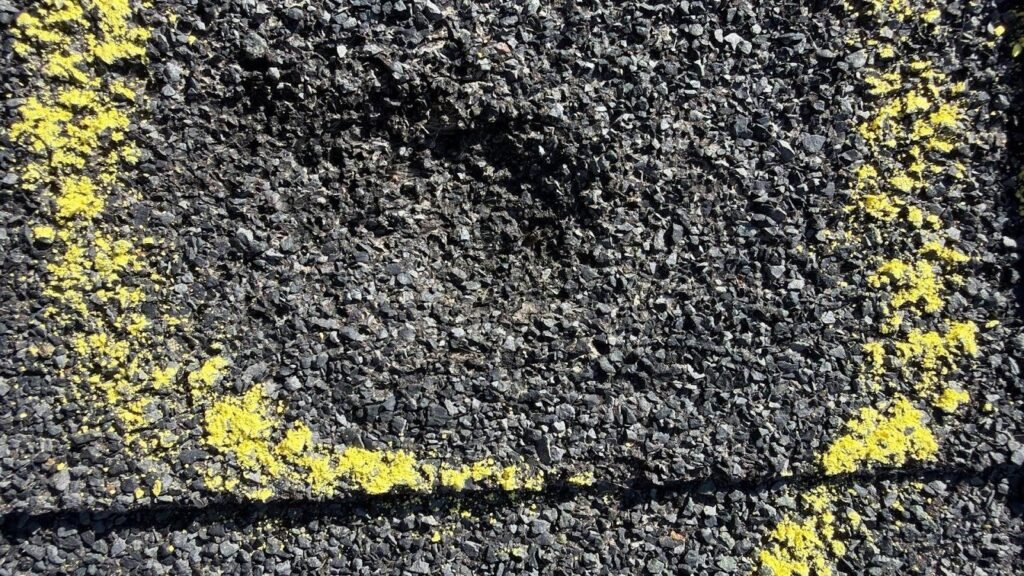
Storm damage often hides in plain sight. This hail bruise was found by hand and chalk-marked during a Utah roof inspection.
Just had hail, a canyon windstorm or heavy snow, and not sure your roof made it through? Most storm damage can’t be seen from the driveway, and a lot of it only shows up months later as a leak. This guide helps you find out what happened to your roof, step by step, without climbing on it.
Water coming in right now? Skip the reading and call (385) 424-8810.
Key Takeaways: What to Know After a Utah Storm
- Stay off the roof: Check from the ground and the attic, and photograph everything with the date showing.
- Know the hail line: Hail 1 inch (quarter size) or larger is "severe" by National Weather Service standards. Dented gutters, vents and AC fins are your best clue.
- Expect wind more than hail: On the Wasatch Front, NOAA recorded 227 damaging-wind events vs. 21 significant-hail events in Salt Lake and Utah counties, 2016 through 2025.
- Report claims promptly: Utah law asks for notice as soon as reasonably possible. Make temporary repairs, but no permanent ones until your insurer inspects.
- Know your rights: Utah bans contractors from rebating your deductible, and you get 5 business days to cancel a storm-repair contract if your claim is denied.
What to Do in the First 48 Hours After a Storm
0–4 hours
4–12 hours
12–24 hours
24–36 hours
36–48 hours
Get everyone safe, stay off the roof, and stop any water coming in.
Check the roof from the ground, the gutters and soft metals, and the attic. Save a few hailstones in the freezer, or photograph them next to a coin.
Photograph everything with the date showing, and write down the storm’s date and time.
Tarp any exposed decking, keep the receipts, and hold off on permanent repairs.
Book a free inspection, and check your deductible (including any wind/hail deductible) and your policy’s claim-reporting rules.
Storm Damage Roof Checklist for Utah Homeowners
Work through these 6 steps after any hail, wind or heavy snow. By the end, you’ll know whether you need an inspection, and you’ll have a record either way.
1. Stay safe first (first 4 hours)
2. Scan the roof from the ground with binoculars (hours 4 to 12)
3. Check gutters and soft metals, your best hail clue (hours 4 to 12)
4. Check inside the house (hours 4 to 12)
5. Build your record (hours 12 to 24)
6. Take action (hours 24 to 48)
Utah's Three Storm Threats to Your Roof
Utah roofs face three kinds of storms, and each damages a roof differently. The storm counts below are for the Wasatch Front (Salt Lake and Utah counties), where we work.
Utah roofs face a storm threat every month of the year. Check yours after each season.
Hail (late spring through September)
Utah hail comes with summer thunderstorms. They are short and intense, and the hail falls in narrow bands that can hit one street and miss the next. NOAA logged 21 significant-hail events (1 inch or larger) in Salt Lake and Utah counties from 2016 through 2025. 2024 was the worst year, with 8.
2026 so far: National Weather Service storm reports show two major hail days on the Wasatch Front.
June 25: golf-ball hail (1.75 in.) in Taylorsville and ping-pong-ball hail (1.5 in.) in Holladay.
September 18: hail up to 2 inches (estimated from photos) near the Layton–Kaysville line, 1.5 in. in Kaysville and Farmington, half-dollar hail in Layton, and quarter-size hail in Taylorsville and West Jordan.
Not sure your roof was hit? Check these 10 signs of hail damage on a Utah roof, or see how the September 2026 hailstorms hit each city.
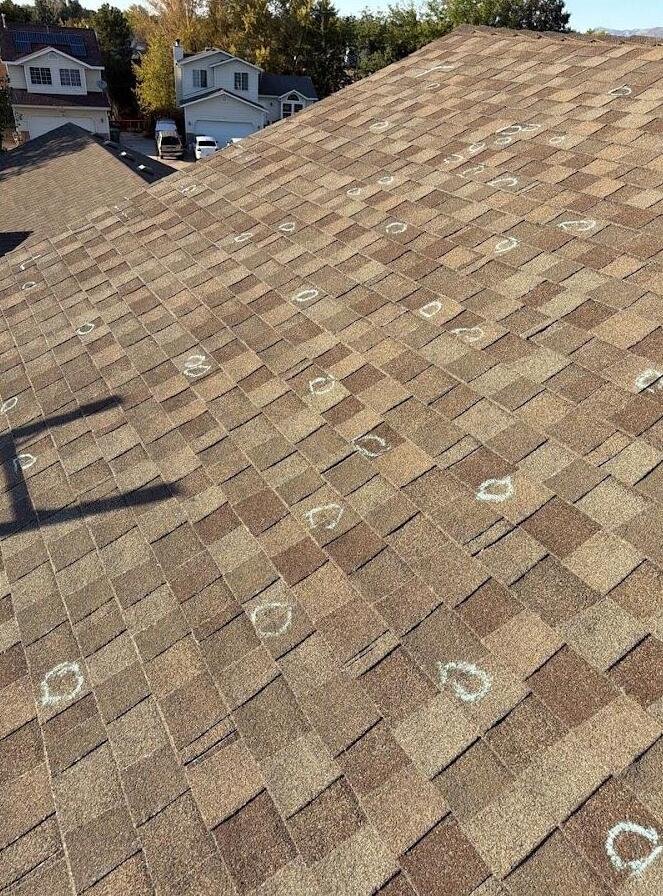
After the September 18, 2026 Wasatch Front hailstorm, every hit on this roof slope was found and chalk-marked.
Wind (canyon winds, plus thunderstorm gusts)
On the Wasatch Front, wind is the more frequent roof threat.
- Where it comes from: downslope winds pouring out of the Wasatch canyons, plus sudden gusts from summer thunderstorms.
- What it damages: ridges, rakes and corners. It creases shingles, breaks the seal strips and peels tabs back to the underlayment.
- How often: NOAA recorded 227 damaging-wind events (58 mph or higher) in Salt Lake and Utah counties over the same decade, more than ten for every significant hailstorm.
- Strongest gust: 83 knots (about 96 mph), in Salt Lake County on July 13, 2024.
See the full 10-year Utah storm history for more of the NOAA data.
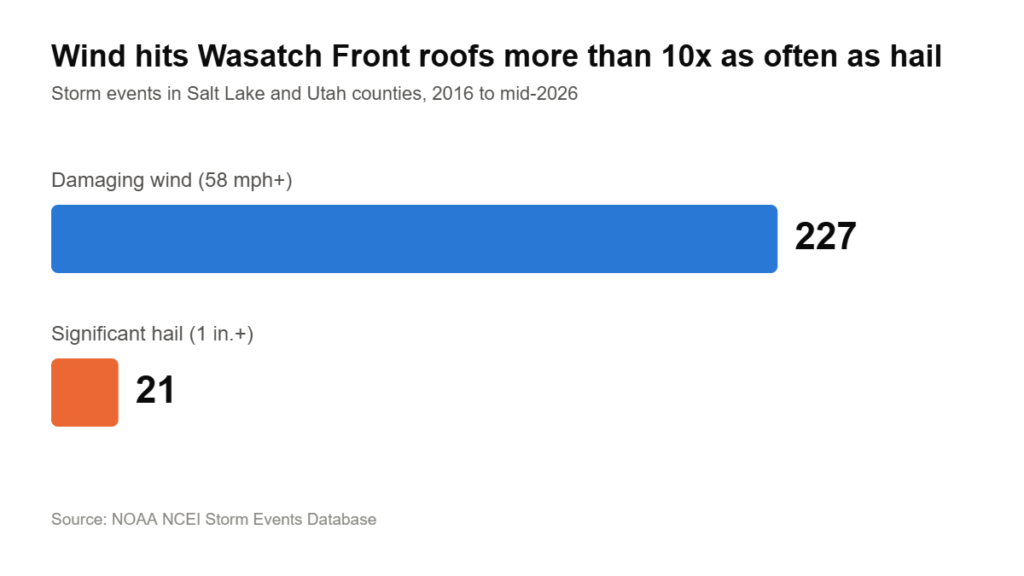
Wind is the Wasatch Front’s most frequent roof threat; hail is rarer but can hit a whole neighborhood at once.
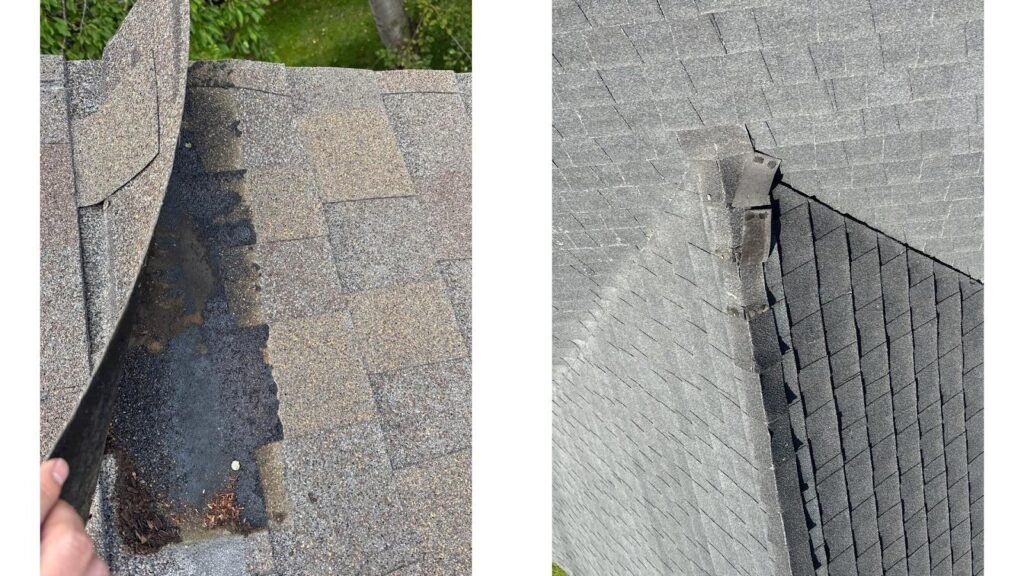
Canyon winds break seal strips and tear tabs (left), and hit ridge caps hardest (right).
Snow and ice (November through March)
Winter storms damage roofs more slowly:
- Ice dams: warm attic air melts snow on the roof, the water refreezes at the cold eaves, and meltwater backs up under the shingles and behind the gutters.
- Snow load: the weight of snow and ice can bend gutters or pull them off the fascia.
- Frozen downspouts: water spills over the edge and against the foundation.
- Made worse by: poor attic ventilation and worn flashing.
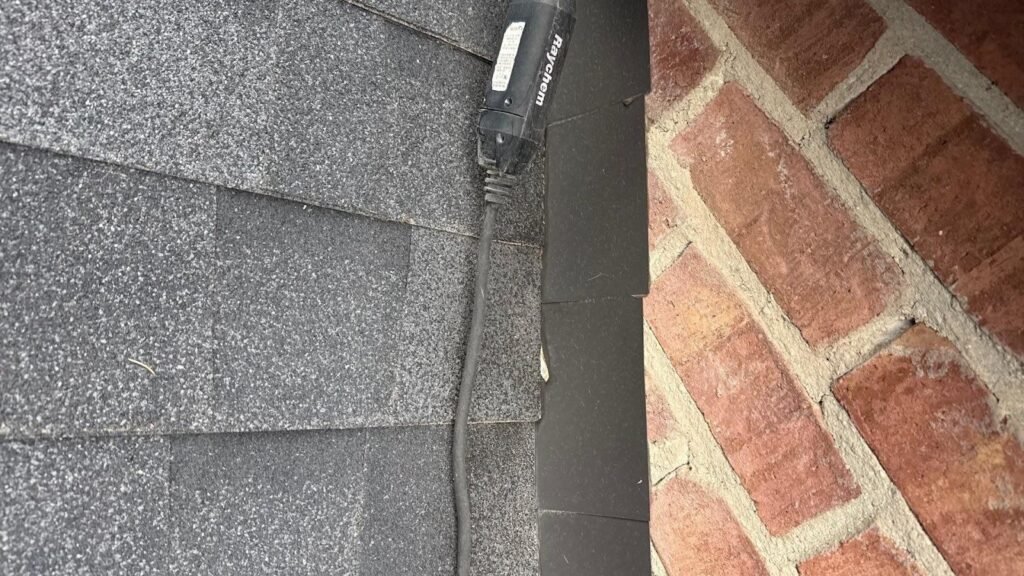
Heat cable keeps snowmelt draining at roof-to-wall joints, where Utah ice dams often force water under the shingles.
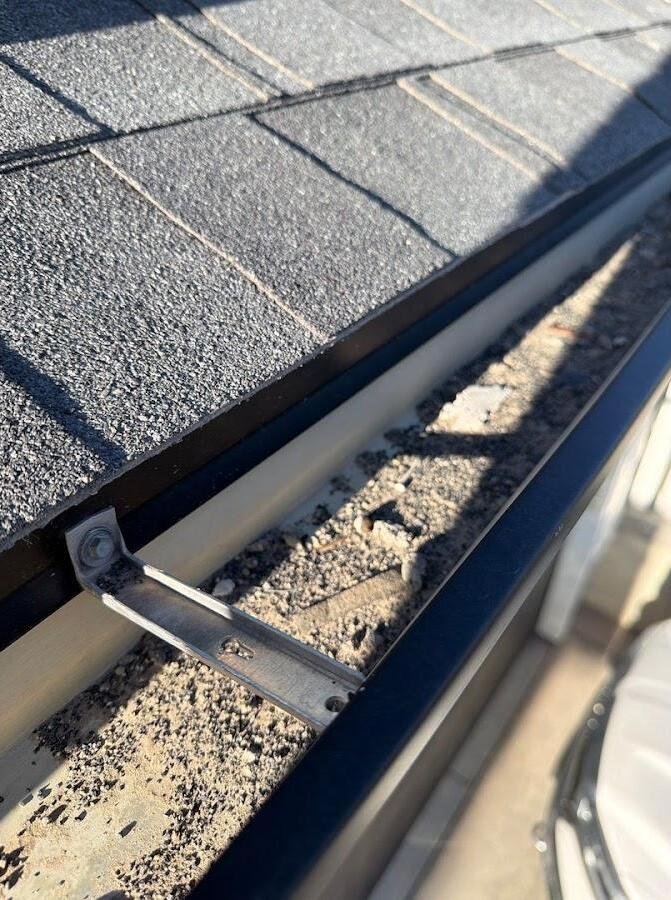
Hidden hangers hold gutters under heavy snow and ice far better than older spike-and-ferrule fasteners.
Most ice dams start in the attic. See how attic ventilation prevents ice dams and how flashing keeps ice-dam water out.
What Size Hail Damages a Roof?
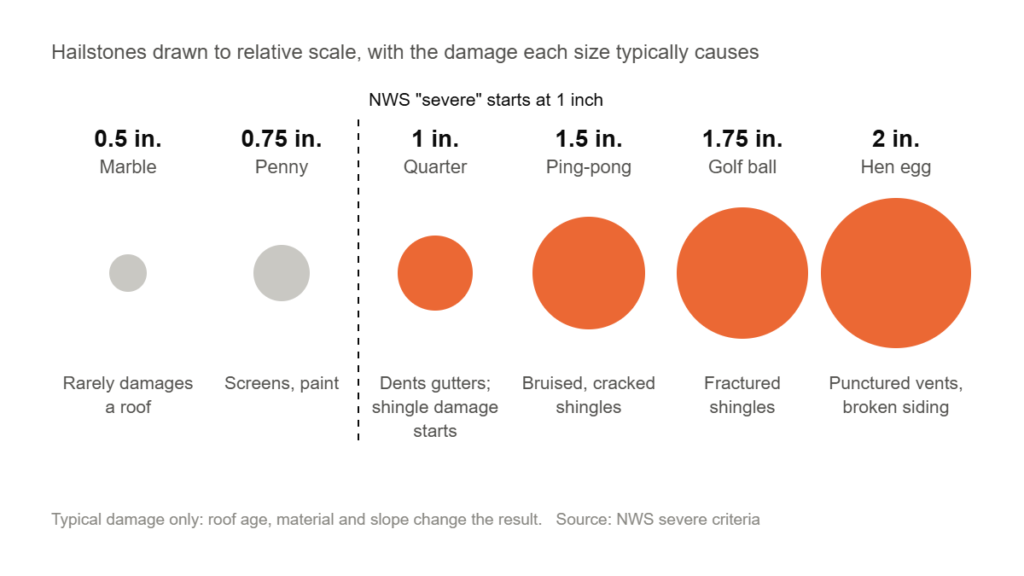
Roof damage from hail usually starts around 1 inch (quarter size), the NWS severe threshold.
| Hail size | Compare to | What it typically damages |
|---|---|---|
| 0.25–0.5 in. | Pea to marble | Rarely damages a roof in one storm. Repeated small-hail storms can wear shingles down over time. |
| 0.75 in. | Penny | Window screens, paint, thin soft metals |
| 1.00 in. | Quarter (NWS “severe” threshold) | Dents gutters, vents and AC fins. Damage to asphalt shingles starts, especially on older roofs. |
| 1.25–1.5 in. | Half-dollar to ping-pong ball | Bruised and cracked shingles. Siding and skylight damage. |
| 1.75–2.0 in. | Golf ball to hen egg | Fractured shingles, punctured vents, broken siding. Have the roof inspected. |
These are typical thresholds only. Roof age, material, slope and wind-driven angle all change the result. IBHS research published in 2025 found that repeated exposure to small hail can reduce a roof’s resistance to later large hail, so a roof that has been through several “minor” storms is more vulnerable.
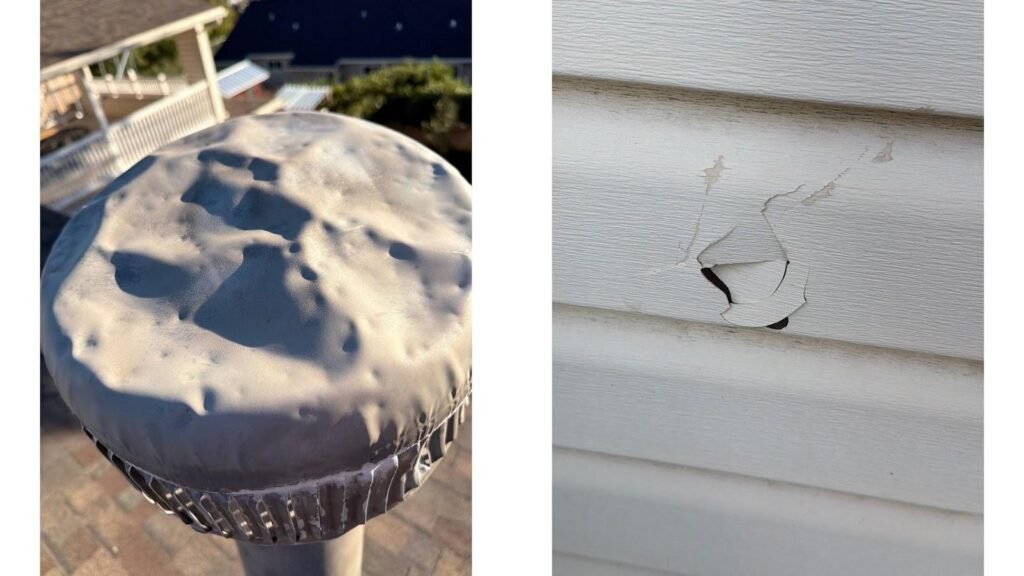
Hail up to 2 inches, reported near Layton on Sept. 18, 2026, can crush soft metals (left) and crack siding (right).
Hail-resistant options: Class 4 shingles carry the highest UL 2218 impact rating (tested with a 2-inch steel ball). They aren’t hail-proof, and any insurance discount for them depends on your insurer, not Utah law.
Signs of Storm Damage by Storm Type
| Storm | What the damage looks like | Where to look | Visible from the ground? |
|---|---|---|---|
| Hail | Round bruises (soft spots), dark spots where granules are missing, cracked shingles, dented vents and gutters | The field of every slope, soft metals, gutters | Rarely. Dents on metal are the giveaway. |
| Wind | Creased or lifted tabs, broken seal strips, missing shingles, torn ridge caps, lifted flashing | Ridges, rakes, eaves, corners | Missing shingles, yes. Creases and broken seals, no. |
| Snow and ice | Ice dams, stains at the eaves, sagging or detached gutters, bent drip edge, wet decking | Eaves, valleys, gutters, attic near exterior walls | Ice dams and gutters, yes. Water under the shingles, no. |
Hail bruises are found by feel, wind creases only show at a low angle, and broken seals only show when a shingle is lifted. That’s why a proper inspection means someone walking every slope.
What a Storm Damage Roof Inspection Covers
A professional storm damage roof inspection (also called a roof storm damage assessment) does two jobs: it finds the damage, and it records the damage so anyone (you, your insurer, a future buyer) can follow it without going up on the roof.
What Gets Checked During an Inspection After a Storm
Every slope, walked rather than sampled from a ladder.
- The field of each slope, plus ridges and edges
- Flashing and every penetration: vents, pipe boots, chimney, skylights
- Gutters and soft metals
- Seal strips, tested by hand
- Hail bruises, found by feel
How an Inspection Photographs the Damage
- Paired photos: a wide shot showing where the problem is on the roof, plus a close-up of each bruise, crease, crack or lifted edge.
- Date-stamped and organized slope by slope, so the set reads like a map of the roof.
- A size reference in the frame (coin, ruler or chalk circle) for hail hits and dents.
- Hail photos taken straight on and close up. Wind photos taken edge-on and low, where a crease catches the light, with seal checks photographed mid-test.
- Urgent items flagged first. Exposed decking or underlayment goes to the top of the report.
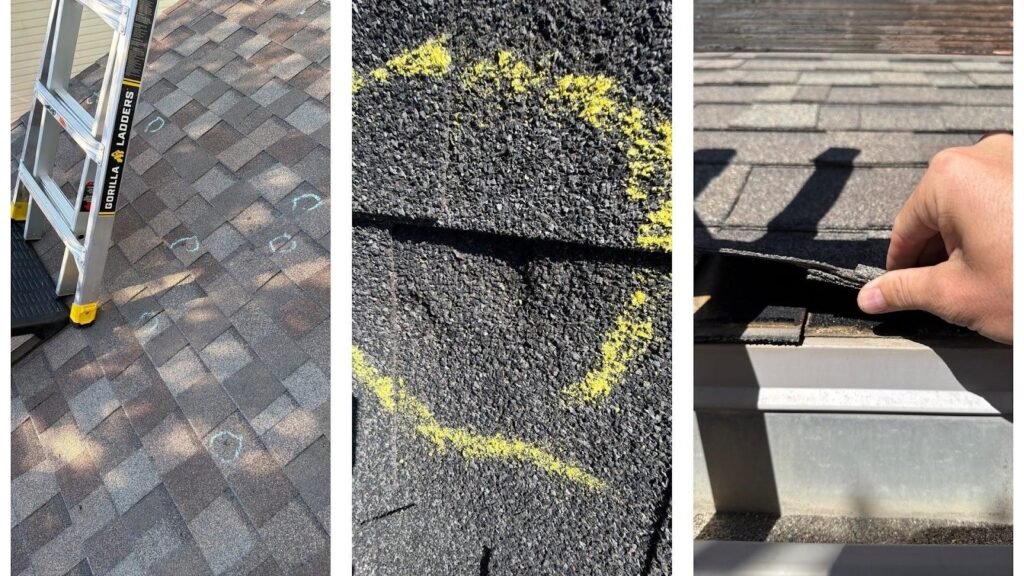
Storm damage photo standards: a slope overview, a close-up of each hit, and a hand seal check photographed mid-test.
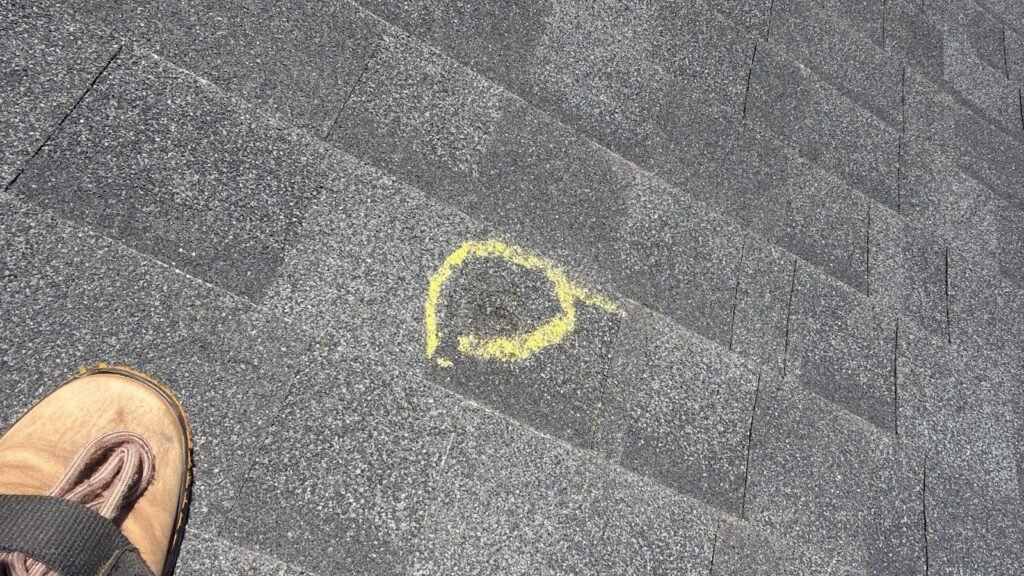
A size reference in each close-up lets homeowners and adjusters judge hail damage without going on the roof.
What you get and keep: the full photo set, a plain-English summary of what was found and where (including “no damage found” when that’s true), and a written estimate if repairs are recommended.
Wondering how often to check? See how often to inspect your roof in Utah, or book a free inspection now.
Storm Damage: Repair or Replace?
Not every storm-damaged roof needs replacing. The choice depends on how far the damage spreads, the roof’s age, and whether a repair will hold and match.
A repair is usually enough when the damage is confined to one slope or edge: a few blown-off or creased shingles, a dented vent, damaged flashing, or a small leak.
Replacement makes sense when the hail damage is widespread across several slopes, the wind damage is extensive, the decking has soaked up water, or the roof is near the end of its life and the shingles can’t be matched or sealed properly.
About the “25% rule”: it’s a rule of thumb borrowed partly from Florida’s building code, not a Utah law. In Utah, what decides repair vs. replacement on an insured claim is the extent of the damage, the building code, your policy, and Utah’s matching rule, explained in the insurance section.
To weigh it up, read how to decide between repair and replacement, the signs you need a new roof, and what a new roof costs in Utah.
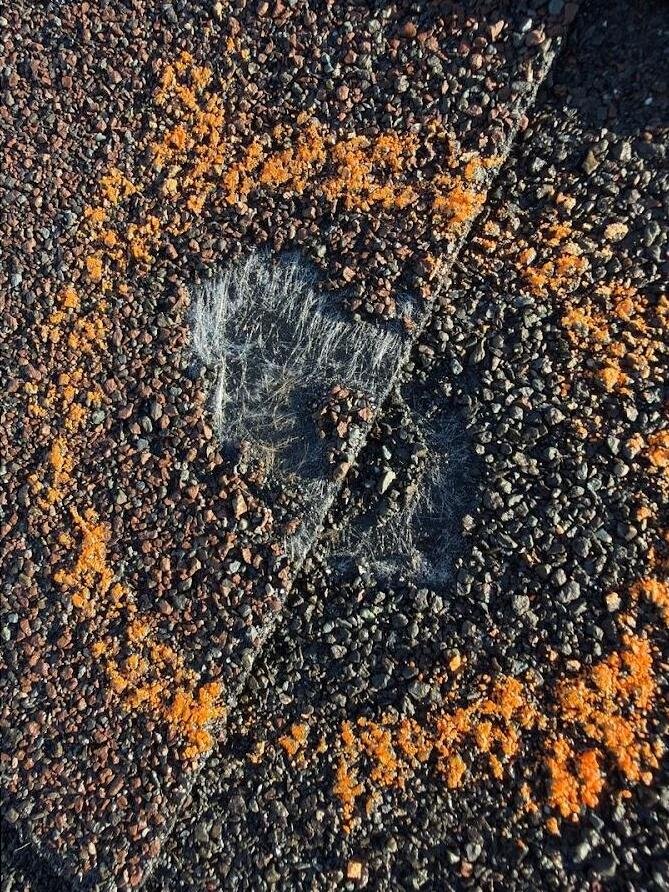
Functional hail damage: this impact broke through to the mat. Damage like this on several slopes usually means replacement.
Storm Damage, Insurance and Utah Law
What a standard Utah homeowners policy usually covers
Here’s what the Utah Insurance Department says most standard homeowners policies cover, and what they usually don’t:
Usually covered
- Wind
- Wind-driven rain
- Trees or other objects falling on the home
- Collapse from the weight of ice or snow
Usually not covered
- Interior water damage from a storm when the roof or walls weren't damaged
- Flood, or water backing up from drains or sewers
- Removing fallen trees that didn't hit the house
- Gradual wear and tear
Ask your agent whether any of the uncovered items can be added to your policy as an endorsement.
How to File a Roof Insurance Claim in Utah
01
Notify your insurer as soon as reasonably possible. Utah law asks for notice “as soon as reasonably possible” (Utah Code 31A-21-312), and your policy may set a stricter deadline.
02
Tarp now, fix later. Make temporary repairs (tarp the roof, cover broken windows) and save every receipt, but hold off on permanent repairs until the insurer has inspected and you’ve agreed on the cost.
03
Know the deadline to sue. A lawsuit over a claim must be filed within three years of the date of loss (Utah Code 31A-21-313).
04
Asking questions won’t raise your rate. An inquiry that doesn’t become a claim can’t by itself raise your premium (Utah Code 31A-19a-212).
05
Matching: on replacement-cost claims, Utah rules require replacement items to give “a reasonably uniform appearance”, inside and out (Utah Admin. Code R590-190-13).
How Rooval Roofing helps: we inspect and document the damage so you have what you need to file. You file the claim. If the repair costs less than your deductible, we’ll let you know and provide a direct written price.
Financing is also available for deductibles and uninsured repairs.
When It Can't Wait: Emergency Storm Damage
Call right away if you see any of these:
- Bare decking or underlayment showing where shingles blew off
- Water coming through a ceiling or light fixture
- A broken skylight, a damaged chimney, or a tree limb on the roof
- A sagging section of roof
Exposed decking can soak up water in a single storm, so get it tarped and keep the receipt for your claim.
Our local crew is based in Utah.
How to Avoid Storm-Chaser Roofers
After a big storm, out-of-state crews often go door to door. Before you sign anything:
- Ask for a Utah contractor license number (roofing classification S280) and check it with DOPL.
- Ask for local references and a local address.
- Walk away from any offer to waive or cover your deductible. It’s illegal in Utah (Utah Code 13-50-302).
- Read before signing a “free inspection” form at the door. Some of these forms are really contracts or an assignment of benefits, which hands a contractor rights under your insurance claim. Utah law sets strict rules for these documents (Utah Code Title 13, Chapter 50). If you don’t understand one, don’t sign it.
- Don’t sign anything that commits you before you’ve seen a written inspection, and remember you can cancel within five business days if the insurer denies the claim in writing (Utah Code 13-50-202).
- Be wary of pressure to “decide today.”
Still have questions? Our roofing FAQ covers more.
How to Protect Your Roof From Storm Damage
Choose impact-resistant shingles
Class 4 (UL 2218) shingles hold up better against hail.
Consider metal roofing
standing-seam metal stands up well to hail and wind, and sheds snow.
Ventilate and insulate the attic
keep the roof deck cold so ice dams don’t form.
Fasten gutters for snow load
sound hangers, clear downspouts, and snow guards where needed.
Book a yearly tune-up
resealing an edge or flashing joint is cheaper than fixing a leak.
Weighing materials? Compare metal roofs and asphalt shingles in Utah.
After the Storm: Check, Photograph, Then Call
Most storm damage hides in plain sight, so don’t wait for a leak to find it. Check your roof from the ground and the attic, photograph what you see, and book a free inspection within a few days.
Filing a claim? Report it promptly and make only temporary repairs until your insurer inspects. Check any roofer’s license before you sign, and if your roof came through fine, we’ll tell you that too.
Utah Storm Damage Roof Library
Storm Damage Roof FAQs
What is considered storm damage to a roof?
Sudden damage caused by a weather event: hail bruises and cracks, shingles creased or blown off by wind, punctures from falling limbs, and damage from the weight of ice or snow. Gradual wear such as aging, curling or general granule loss isn’t storm damage.
Can storm damage cause roof leaks months later?
Yes. Hail bruises keep shedding granules, and a shingle with a broken seal strip can lift in the next windstorm. A roof that looks fine after a storm can start leaking months later, so document the damage while it’s fresh, even if nothing leaks yet.
What's the difference between replacement cost and actual cash value on a roof claim?
A replacement cost policy pays to repair or replace the roof with materials of like kind and quality. An actual cash value policy also takes off depreciation for the roof’s age and wear, so an older roof gets a smaller payout. Your declarations page shows which one you have.
How do you prevent ice dams?
Keep the roof deck cold and let water drain. Air-seal and insulate the attic, balance soffit and ridge ventilation, keep gutters and downspouts clear, and use ice-and-water shield at the eaves when the roof is replaced. Heat cable helps at problem spots. After heavy snow, pull snow off the lower roof with a roof rake from the ground, and never chip at the ice, which damages shingles.
How soon after a storm should I get my roof inspected?
Within a few days if you can. Fresh damage is easiest to find and photograph before rain washes the granules away.
What is a wind/hail deductible?
Some policies have a separate deductible just for wind and hail claims. It’s often a percentage of your coverage, typically 1% to 5%, rather than a flat amount. With $200,000 of coverage, a 1% deductible means you pay the first $2,000 of every wind or hail claim. Check your policy or ask your agent.
Should I call my insurance company or a roofer first?
Many homeowners book a free inspection first, so they know whether there’s real damage, and roughly what the repair costs, before opening a claim.
Is it worth filing an insurance claim for hail damage?
Compare the repair estimate with your deductible, including any separate wind/hail deductible. If the repair costs about the same as the deductible, paying directly is usually simpler. If hail damaged several slopes, the gutters or the siding, a claim is usually worth it. A free inspection gives you the numbers to decide.
Will my insurance go up if I file a roof claim in Utah?
It can. Utah’s protection covers questions that don’t turn into a claim (Utah Code 31A-19a-212), not claims themselves. Before you file, ask your agent how your insurer treats weather claims at renewal.
What can I do if my roof claim is denied or the payout seems low?
Ask for the decision in writing, compare it with your inspection photos, and ask the insurer to re-inspect. If you still disagree, the Utah Insurance Department helps with claim settlement disputes at 801-957-9305 or 800-439-3805, though it can’t order an insurer to pay.
Storm Damage Help Across the Wasatch Front
We inspect, document, and repair storm damage throughout Utah County, the Salt Lake Valley, and Davis County, including
See all service areas.
Had a Storm Roll Through? Get a Straight Answer.
- Free inspection
- date-stamped photos you keep
- local Utah crew
- licensed & insured (Utah GC Lic. #13861046-5501)
- financing available
This guide is general information, not legal or insurance advice. Your coverage depends on your policy, and the Utah laws cited were checked in October 2026. For advice on your claim, talk to your agent or a licensed Utah attorney. Rooval Roofing is a roofing contractor, not a public adjuster.
ABOUT ROOVAL ROOFING
Roofing Without the Guesswork
Rooval Roofing is a family-run roofer in Lehi, Utah, serving homeowners across Utah County, the Salt Lake Valley and Davis County. We judge every roof on its actual condition, inspecting the roof and attic, documenting what we find, and telling you plainly whether it needs a repair, a replacement, or nothing at all. Clear answers, practical advice and workmanship that holds up.
Licensed and insured · Utah GC Lic. #13861046-5501 · Lehi, Utah · (385) 424-8810