Hail damage rarely announces itself. A roof can look completely normal from the driveway while the shingles above are already compromised: bruised, cracked, or missing the granules that protect them from sun and water. Most of what matters here isn’t visible unless someone actually gets on the roof.
Dented gutters and vent caps, granules collecting in your downspouts, and dark spots on shingles are the clues you can catch from the ground. Circular bruising, broken seal strips, cracked shingles, and exposed underlayment only show up on the roof itself. Attic staining and daylight through the deck mean water’s already gotten in.
Here are the 10 signs to look for, broken down by ground, roof, and interior.
Key Takeaways: Attic Ventilation in Utah
- Most functional hail damage isn’t visible without touching the shingle.
- Dented soft metals (gutters, vents, flashing) are the most reliable proof a storm hit hard enough to matter.
- Some signs mean “get this looked at soon,” others mean “call today.”
- A free inspection settles it either way, including telling you if your roof is fine.
Ground-Level Signs of Hail Damage You Can Check Yourself
You don’t need a ladder for these. Walk the perimeter of the house and look at anything metal.
01 Dented gutters, downspouts, and vent caps
Soft metals dent easily and hold the shape permanently. Unlike shingles, they don’t weather back to normal. A row of fresh circular dents along a gutter run is the clearest sign hail hit hard enough to matter, and it tells an inspector roughly what to expect on the roof above it.
02 Granules piling up in gutters and at the base of downspouts
Those small, sand-like grains are the protective coating on asphalt shingles. Hail knocks them loose. A light dusting after a storm is normal wear; a heavy accumulation means shingles lost more coating than they should have, and the bare asphalt underneath is now exposed to UV.
03 Damage to everything else around the house
Dented AC fins, cracked vinyl siding, torn window screens, chipped deck paint. None of this is roof damage, but it’s useful evidence: if hail was strong enough to dent your air conditioner, it was strong enough to bruise your shingles too.
Roof-Level Signs of Hail Damage (Inspection Only, Don’t Climb Up)
These are the signs that actually require a rooftop inspection, either binoculars from the ground or a professional walking the slopes.
| Don’t climb up yourself to check these; a hail-covered roof is slippery, and stepping on bruised shingles can add damage an adjuster later mistakes for foot traffic. |
04 Circular bruising on the shingles
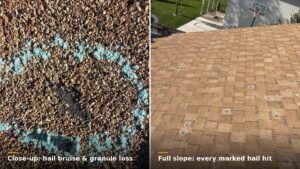
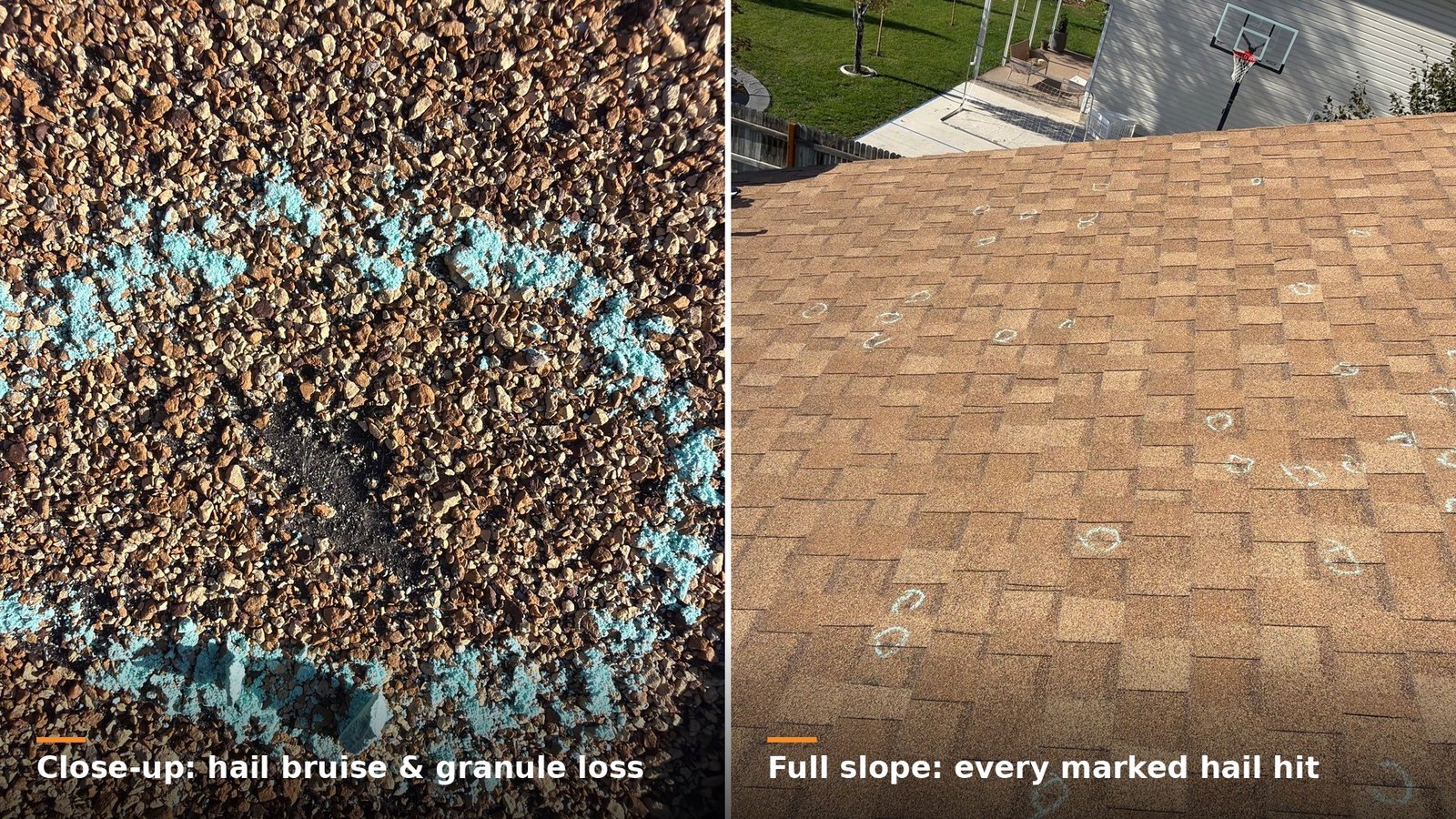
This is the core hail injury. The impact crushes granules into the mat and can fracture the fiberglass layer underneath, the part that actually keeps water out. A bruise feels soft or spongy under a hand, but from a distance it just looks like a slightly darker, dimpled spot. It rarely leaks right away; it just gets worse every season it’s left alone.
05 Broken seal strips or lifted shingle tabs
Wind that rides in with a hailstorm can snap the factory adhesive bond holding a shingle flat. The shingle often settles right back down and looks fine, but the seal is gone, and it’s now loose and ready to tear off, or let rain blow underneath, the next time wind picks up.
06 Cracked or split shingles (or tiles)
Bigger hail can snap a shingle outright, or crack a concrete or clay tile at the corner. Unlike a bruise, a crack is an immediate water path; there’s no “wait and see” here.
07 Damaged or lifted flashing
The metal around chimneys, skylights, and valleys is thinner and more exposed than shingles, so it dents and shifts more easily. Once it’s bent or pulled loose, the seal underneath it goes with it.
08 Missing shingles with exposed underlayment
If wind tore off a section entirely, you’ll see bare black or gray material where shingles used to be. That underlayment isn’t built to survive long-term sun exposure; it’s a temporary layer, not a roof.
| Not sure which of these apply to your roof? That’s exactly what a free inspection is for. We walk every slope, check seals by hand, and give you a straight answer in writing, including “no damage found” when that’s the truth. Book a free storm inspection |
Signs Inside Your Attic & Roof Valleys
09 Water stains, mold smell, or daylight in the attic
By the time a stain reaches your ceiling, water has already worked through the shingles, underlayment, and insulation. Check the attic directly after a storm; brown rings, damp insulation, or a musty smell are earlier warnings than anything you’ll see on the ceiling below.
10 Debris pooling in valleys and low points
Storms wash leaves, granules, and branches into the low spots where roof slopes meet. Left there, it dams water instead of letting it drain, and standing water works its way under the shingle laps faster than you’d expect.
What Size Hail Causes Roof Damage in Utah?
Size matters more than most homeowners assume: a pea-sized hailstone and a golf-ball-sized one leave very different roofs behind. The National Weather Service hail-size guide uses standard comparisons such as quarter-size for 1-inch hail and half-dollar-size for 1.25-inch hail
| Hail Size | What It Typically Does |
| Under ¾ in (pea) | Minimal functional damage on a newer roof; accelerates aging on an older one |
| ¾ in – 1 in (penny to quarter) | Granule loss and light bruising, especially on shingles over 10 years old |
| 1 in – 1.5 in (quarter to half-dollar) | Functional shingle damage becomes likely. This is where most insurance claims start |
| 1.5 in and up (golf ball+) | Damage across shingles, soft metals, siding, and tile is essentially guaranteed |
Utah’s hail season runs roughly May through September, peaking in June and July, when afternoon thunderstorms build over the mountains and push into the valleys.
Impact resistance also varies by roofing product. UL Solutions explains UL 2218, a standard that uses steel-ball impacts to classify roofing materials from Class 1 through Class 4.
| Did Your City Just Get Hit? See the hail sizes reported across northern Utah and what each one typically means for a shingle roof. September 2026 Utah Hailstorms, City By City → |
Why Hail Damage Doesn’t Always Leak Right Away
A hail bruise fractures the shingle’s waterproof layer without breaking the surface. Through late summer and fall, that weak spot absorbs a little moisture with every rain. Then winter’s freeze-thaw cycle takes over: water trapped in the fracture expands as it freezes, widening the crack a little more each cold night. By the time a ceiling stain shows up, the damage is months old.
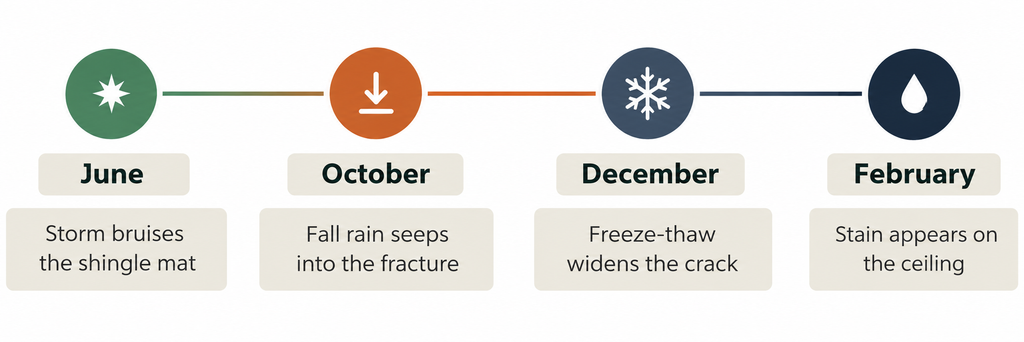
That gap between the storm and the visible leak is exactly why an inspection after hail matters, even when nothing looks wrong yet.
Does Homeowners Insurance Cover Hail Damage in Utah?
Utah homeowners policies typically cover hail and wind, but a few local specifics are worth knowing before you file a claim:
- Many Utah policies now use a percentage-based deductible for hail and wind (often 1-2% of your dwelling coverage) rather than a flat dollar amount; it’s worth checking your policy before assuming your deductible is $1,000.
- Insurers distinguish between cosmetic damage (surface only, doesn’t affect function) and functional damage (compromises the waterproofing); this distinction often decides whether a claim is approved.
- A roofing contractor can document damage and meet your adjuster on-site, but can’t negotiate your claim settlement for you; that’s the homeowner’s call, working directly with the insurer.
How to Avoid Storm Chaser Roofers in Utah
After any major hailstorm, out-of-state crews sometimes show up knocking on doors. A few quick checks protect you:
- Verify the contractor holds an active Utah contractor license through the Utah Division of Professional Licensing’s contractor search before signing a contract.
- Confirm they have a local, physical address, not just a truck and a phone number.
- Be wary of anyone offering to cover your insurance deductible; that’s actually prohibited under Utah law.
- Don’t sign an “Assignment of Benefits” contract without understanding what rights you’re handing over.
What to Do After a Hailstorm
Hail damage isn’t always obvious from the ground, and a roof that looks fine immediately after a storm can still have bruised shingles, broken seals, or other damage that worsens over time. If your home was in the path of a significant hailstorm, checking the roof, gutters, flashing, and attic can help catch problems before they turn into leaks.
If you’re unsure what you’re seeing, a professional inspection can document the roof’s condition and tell you whether it needs a repair, replacement, or no work at all.
| Get a Straight Answer on Your Roof Free inspection, real photos of your roof’s condition, and a written report before any work starts. Book My Free Inspection · Call (385) 424-8810 |
Frequently Asked Questions
Dark, circular depressions where granules have been knocked loose, exposing the asphalt underneath. Bruised areas often feel soft or spongy when pressed, because the mat beneath the surface has fractured.
Partially. Large hail (1.25 inches and up) often shows as dented gutters, ridge caps, or torn shingles. But granule loss and mat bruising, the damage that actually matters long-term, usually require a close, hands-on rooftop check.
No. Hail rarely punches a clean hole; it weakens the waterproofing layer. Leaks often show up weeks or months later, after more rain or a winter freeze-thaw cycle finishes what the storm started.
Yes, for any licensed local roofer worth hiring. It should come with zero obligation and honest documentation either way.